-
VMAP SC Newsletter
January 2026
As we step into 2026, we wish all members of the VMAP Standards Community a happy and productive new year. The past few months have been busy with project meetings, technical progress, and growing collaboration across our community—and we’re excited to share some of these updates with you.
VMAP Standards and Ontologies Presented at MaterialDigital General Assembly
At the 2025 MaterialDigital General Assembly, the German materials community engaged in intensive discussions about current developments in Workflows, IT Architecture, and Semantic Interoperability. The three-day MaterialDigital General Assembly took place at the end of November at BAM in Berlin.
As an invited keynote speech, Klaus Wolf presented the latest developments in the VMAP standard and its application in ongoing research projects to the 150 conference participants.
As a project partner in EU Projects ALABAMA, RESTORE, Pioneer, BASE, SmartEM, GEAR-UP, Fraunhofer SCAI is actively working on the standardization of data and semantic modelling using ontologies.
Standards and ontologies play a crucial role in making interoperability in the simulation domain. Moreover, ontologies provide a stable backbone for the knowledge graphs which can significantly facilitate digitalization in the manufacturing sector.The domain ontologies can largely help in building the semantic web for a specific field and then assist with knowledge management by enabling data integration, sharing and retrieval across various systems and organizations. They play an integral role in achieving interoperability in the system and across the workflows. With a common language, ontology can enable logical reasoning over datasets and support a consistent data representation. DOAM, BATTINFO, MpCCI Ontology are some of the domain specific ontologies which are being used for semantic modelling.
The talk provided a brief overview of the VMAP Standard and ontologies including the Common Information Model and how they can assist in digitalization efforts for the manufacturing sector.
Virtual Testing as the Foundation for Additive Manufacturing
Following the productive discussions at the VMAP User Forum 2025 in February, a clear consensus emerged: the additive manufacturing industry urgently needs standardized data formats. In response to this demand, the VMAP SC has established a dedicated Additive Manufacturing Working Group to develop comprehensive standards for AM processes.
Key Objectives Driving Innovation
The working group is focused on four critical areas that will transform how AM data is managed and shared:
In November, Priyanka Gulati had the opportunity to speak at the NAFEMS DACH FEA Seminar 2025 “Symbiose von Simulation und Test”, representing both Fraunhofer SCAI and VMAP SC. The presentation focused on a topic that sits right at the heart of modern engineering workflows: Virtual Testing as the Foundation for Additive Manufacturing Processes.
Additive manufacturing offers enormous design freedom, but it also introduces new challenges in understanding material behaviour, process variability, and performance under real-world conditions. This is exactly where virtual testing becomes a powerful foundation. By connecting simulation with physical test data, we can validate assumptions earlier, improve model accuracy, and support more reliable decision-making throughout the product lifecycle. From the discussions during the seminar, two themes stood out very clearly.
Toward a Unified Data Ecosystem
Virtual testing only unlocks its full potential when simulation and physical test data can meaningfully interact. Many engineering teams still work with disconnected systems, proprietary formats, and isolated workflows. This leads to duplicated effort, inconsistent results, and lost context. A unified, interoperable data ecosystem changes that. When simulation results, measurements, and validation data are stored in structured, vendor-neutral formats, we gain:
- traceability across the full workflow
- higher confidence in virtual validation
- more efficient development loops
- better reuse of knowledge across teams and projects
This is exactly the direction we are working towards at VMAP SC: enabling consistent, standardized data exchange so that virtual testing can truly support engineering innovation.
Collaboration Across Simulation and Testing
Another strong theme throughout the event was the value of collaboration between simulation experts, test engineers, data managers, and domain specialists. Integrating simulation and test data is not only a technical challenge, but also a collaborative one. Shared workflows, shared understanding, and shared objectives are essential. When the people responsible for modelling, testing, materials, and data infrastructure work together, virtual testing becomes a powerful enabler rather than an isolated step in the process. This mindset also reflects the daily work at Fraunhofer SCAI, where we focus not only on advancing simulation technology, but also on how it can be embedded meaningfully into industrial processes.
Looking Ahead
Virtual testing is no longer just an add-on to physical validation. It is becoming a central pillar in ensuring that new manufacturing technologies like AM can scale reliably and responsibly. With stronger data foundations and closer collaboration across disciplines, we can move toward smarter, more connected engineering ecosystems.
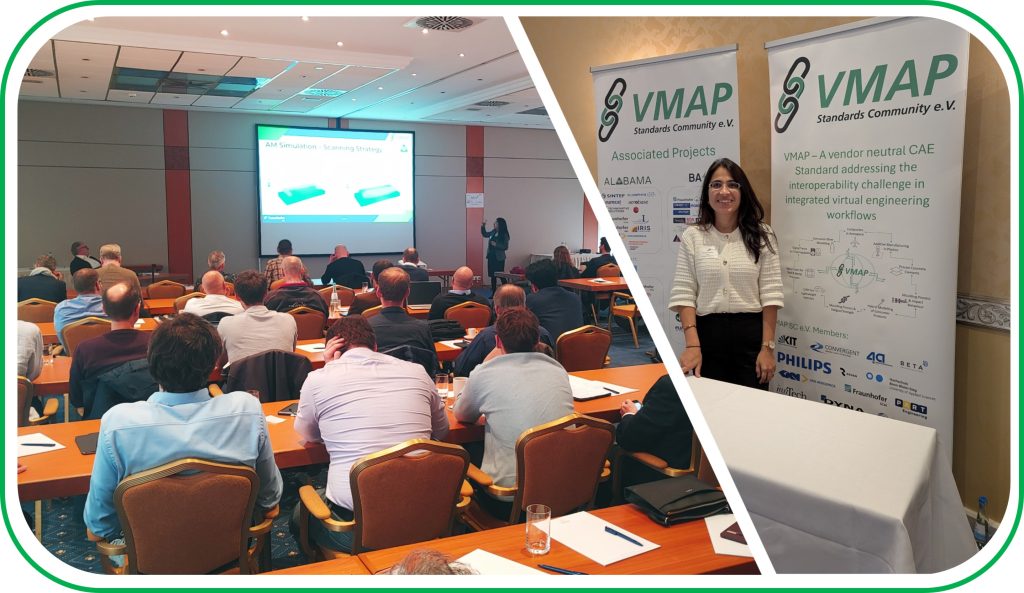
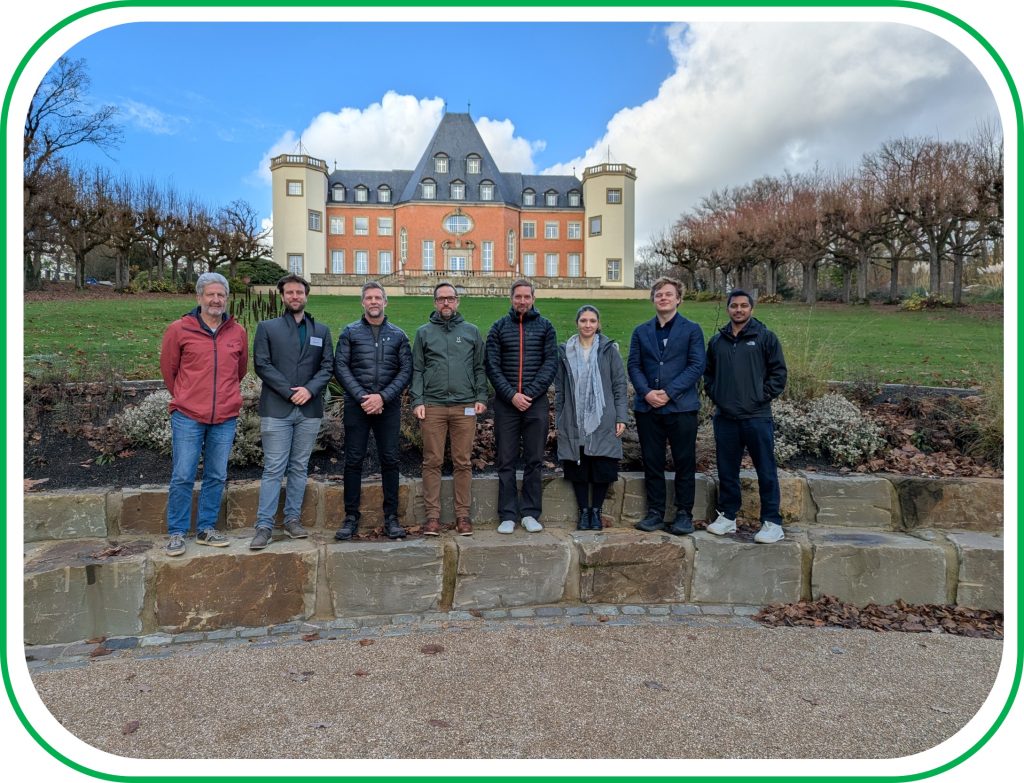
VMAP SC at NAFEMS DACH FEA Seminar 2025 ALABAMA Project’s Mid-Term General Assembly at Schloss Birlinghoven
The ALABAMA Project partners gathered at Schloss Birlinghoven in mid-November. The meeting gave us a chance to step back and see just how far we’ve come, as we’re now at the halfway point of this four-year project journey.
The project’s focus is ambitious: developing a formation system for multi-laser metal additive manufacturing. What struck most during these two days was seeing the physical coupons that various partners have produced. These aren’t just test pieces—they’re the foundation for understanding how different process parameters affect part quality. The team has been putting these coupons through functional testing in the multi-laser setup, and you can read more about that work here.
Aerobase demonstrated their software for AI-driven tool path generation. Watching them work through actual scenarios showed how machine learning is starting to make real inroads in additive manufacturing planning. Meanwhile, Flowphys shared updates on their melt pool simulation work—the kind of detailed physics modelling that helps us understand what’s actually happening when multiple laser beams interact with metal powder.
From the VMAP perspective, Fraunhofer SCAI presented their progress on connecting standardized datasets with the VMAP Ontology. They’ve been working on semantic search capabilities that could help us find and reuse process data more effectively. It’s one thing to collect data; it’s another to make it actually findable and usable across different systems and organizations.
Beyond the technical sessions, the partners took time to appreciate where we were meeting. Schloss Birlinghoven itself is striking, built as a villa at the turn of the 20th century, and nestled in the Birlinghoven forest, it has housed research institutes since the 1960s. We toured the computing center at Fraunhofer SCAI, and in the evening, everyone gathered at a local German restaurant for dinner. There’s something about sharing a meal and taking in the surroundings that helps turn a collection of organizations into an actual working team.
Looking ahead, there’s substantial work still to do. We need to complete the coupon testing and—perhaps more importantly—organize all the data we’re generating in ways that will be useful beyond this project. With two years remaining, the focus is shifting from initial development to achieving our project & use case-specific goals, and ensuring the work translates into knowledge and capabilities the broader community can build on.
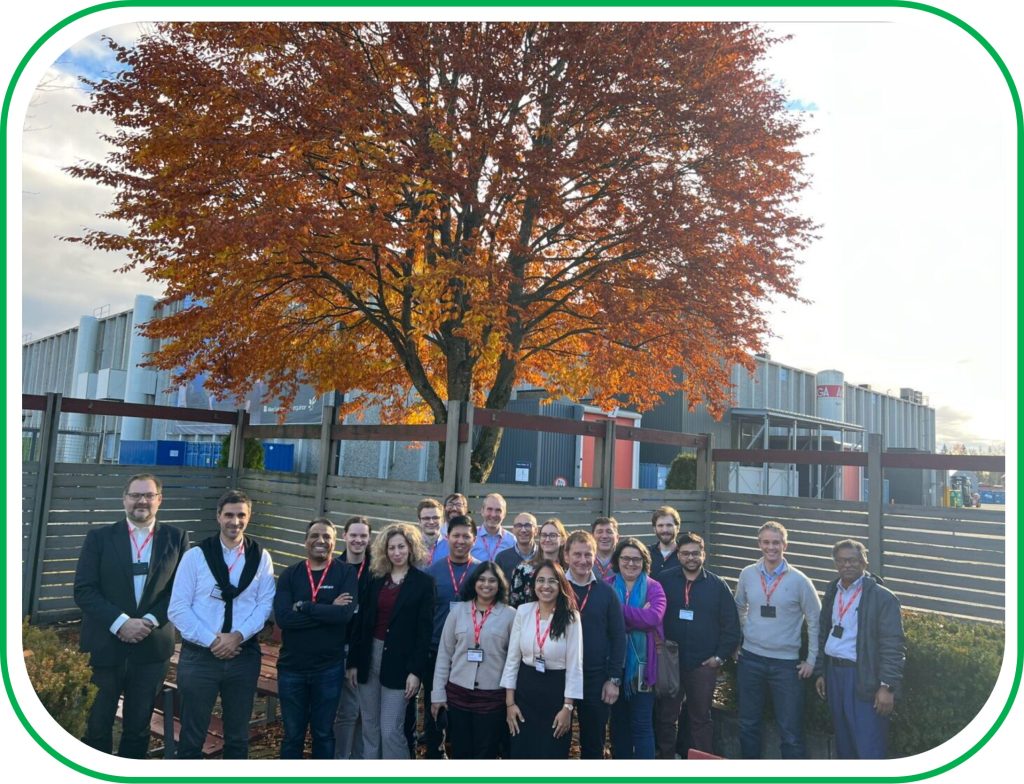
ALABAMA Project Meeting at Schloss Birlinghoven, Germany GEAR-UP Project’s Third General Assembly in Norway
The GEAR-UP Project held its third general assembly in late October, hosted by Aker Solutions and 3D Production in the Norwegian region of Buskerud. this meeting gave partners a chance to look at some impressive production capabilities—from massive hydroturbines to intricate 3D printed components.
The meeting brought together partners from across the consortium to share progress on their respective work packages. Aerobase presented their AI-based material data search tool, which aims to make it easier to find and leverage existing material information for additive manufacturing applications. CelluCircle showcased their advances in developing nanocomposite and thermomechanical filament technologies derived from recycled textiles—work that ties directly into the project’s sustainability goals.
From the standards perspective, Fraunhofer SCAI shared their progress on extending the MpCCI Ontology for additive manufacturing processes using the EMMO/DOAM Ontology framework.
The presentations sparked constructive discussions and collaboration across the different technical domains. For a project like GEAR-UP, which spans materials development, process simulation, AI tools, and data standardization, these face-to-face meetings are essential for ensuring the pieces fit together coherently.
The assembly marked an important milestone, with partners taking stock of what’s been accomplished and mapping out the strategic direction ahead.
Gear-Up Project Partners at Aker Solutions, Norway Pioneer Project’s Final Technical Meeting in Vigo
The Pioneer project partners recently held their final technical meeting in Vigo, Spain, hosted at the premises of the AIMEN Technical Laser Center. The meeting focused on the upcoming final review in February 2026. The partners aligned on the remaining steps required for the realization of the project demonstrators, particularly in the areas of Wire Arc Additive Manufacturing (WAAM), led by partner MX3D, and Sheet Moulding Compound (SMC), led by partner Marelli.
A central topic of discussion was the integration of data generated across the entire development chain, including materials characterization, design activities, simulation results, machine monitoring data, and physical product testing. Ensuring seamless data flow and consistency among these domains was identified as a key enabler for achieving the project’s objectives. To support this integration, VMAP has been adopted as the open standard for managing most technical data. This approach is complemented using ontologies, which provide a structured semantic framework to organize the datasets and establish meaningful links between them, thereby enhancing data interoperability and traceability across the project.
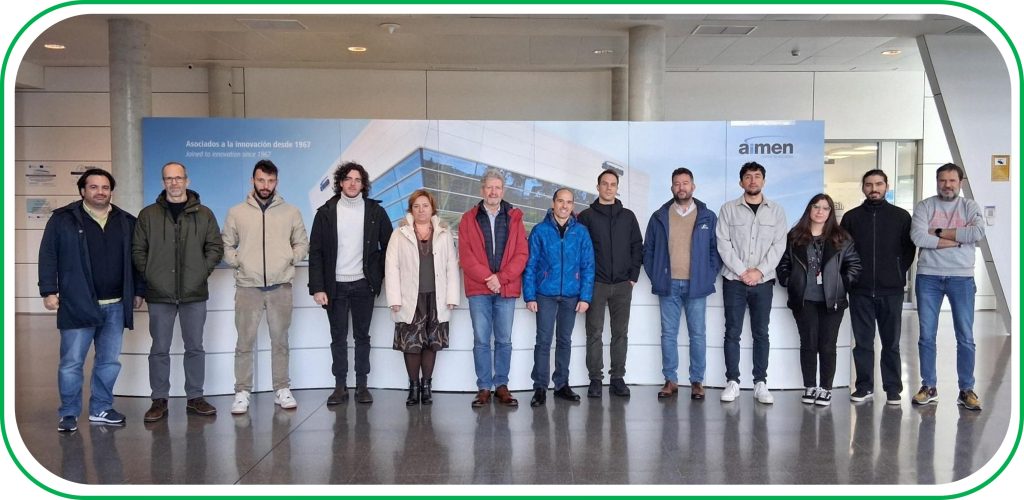
Pioneer Project Partners at AIMEN, Spain VMAP User Forum 2026: Shaping the Future of Digital Manufacturing Through Advanced Standards
Save the Date: February 24-25, 2026 | Schloss Birlinghoven, Germany
We are excited to announce that the VMAP User Forum 2026 is shaping up to be our most comprehensive event yet, with an exceptional lineup of presentations from leading experts across industry, research, and software development.
This year’s forum features 12 outstanding presentations covering the full spectrum of digital manufacturing innovation:
VMAP based Software Solutions
- VMAP IOlib, Wrappers and Format Converter (VMAP SC)
- Explore your VMAP data with ParaView (Kitware)
VMAP based Use Case Integration
- PIONEER: Building the bridge between modelling, manufacturing, and data-driven innovation (AIMEN)
- Enabling Digital Continuity in Virtual Manufacturing for Eco-Efficiency Assessment of Lightweight Structures by Means of a Domain-Specific Structural Mechanics Language (DLR)
- Application of the VMAP Standard in the Integra-tive Development and Optimization of Industrial Packaging (HSBRS)
VMAP Future Requirements
- BASE-Digital Battery Passport: Common Ontology Concept for various systems (FhG SCAI- VMD)
- Smart CAE Data Analysis and Enhancement Requirements for VMAP (FhG SCAI – NDV)
VMAP for Additive Manufacturing
- Common data exchange in additive manufacturing (amSight)
- AI-based path generation for additive manufacturing (Aerobase)
- Gear-Up Project: In-process NDT and adaptive laser control for quality assurance of additively manufactured metallic components (SINTEF)
VMAP and Semantic Concepts
- Semantic Material Data for Simulation: A CAE-Neutral Framework Based on JSON, Knowledge Graphs, and VDA231-301 (MatPlus GmbH)
- Digital Transformation in Materials Science: PMD Core Ontology (PMDco) – Patterns & Applications (BAM)
- MpCCI SIMS – Semantic Information Management based on VMAP Ontology Concepts (FhG SCAI – MP)
Event Details
The two-day forum combines keynote presentations, technical sessions, and valuable networking opportunities. Following the remarkable success of our 2024 and 2025 events, we expect many industry experts to gather at the prestigious Schloss Birlinghoven. Key Information:
- Dates: February 24-25, 2026
- Location: Schloss Birlinghoven, Sankt Augustin, Germany
- Registration Deadline: February 10, 2026
- Conference Fees:
- Members: €200 + VAT
- Non-Members: €350 + VAT
- Students: €100 + VAT
Still Open for Presentations
We are accepting a few more high-quality presentation proposals, particularly in the software/tools and ontologies/semantics domains. This is an excellent opportunity to showcase your work to key stakeholders in the VMAP community.
How to Participate
Register now at VMAP User Forum 2026. For presentation proposals or questions, contact Priyanka Gulati
Join us in shaping the future of digital manufacturing through advanced data standards!Upcoming Working Group Meetings
Full Model Storage 19.01.2026 at 09:30 Additive Manufacturing 02.02.2026 at 13:00 Written by: Priyanka Gulati